

- Tel: 0086-21-37901188
- E-mail: info@triowin.com
- whatsapp: +8613301885621
- wechat: 13301885621
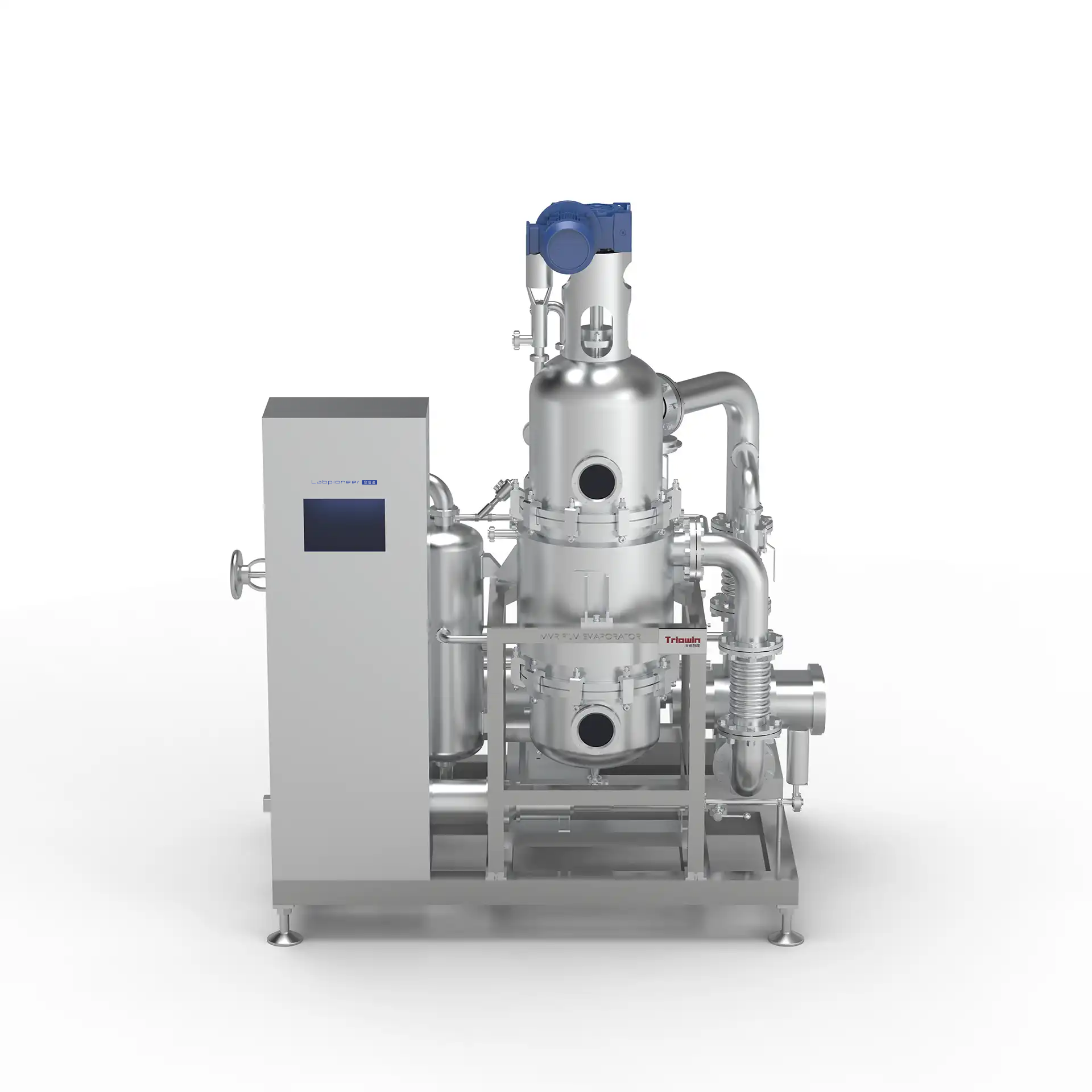
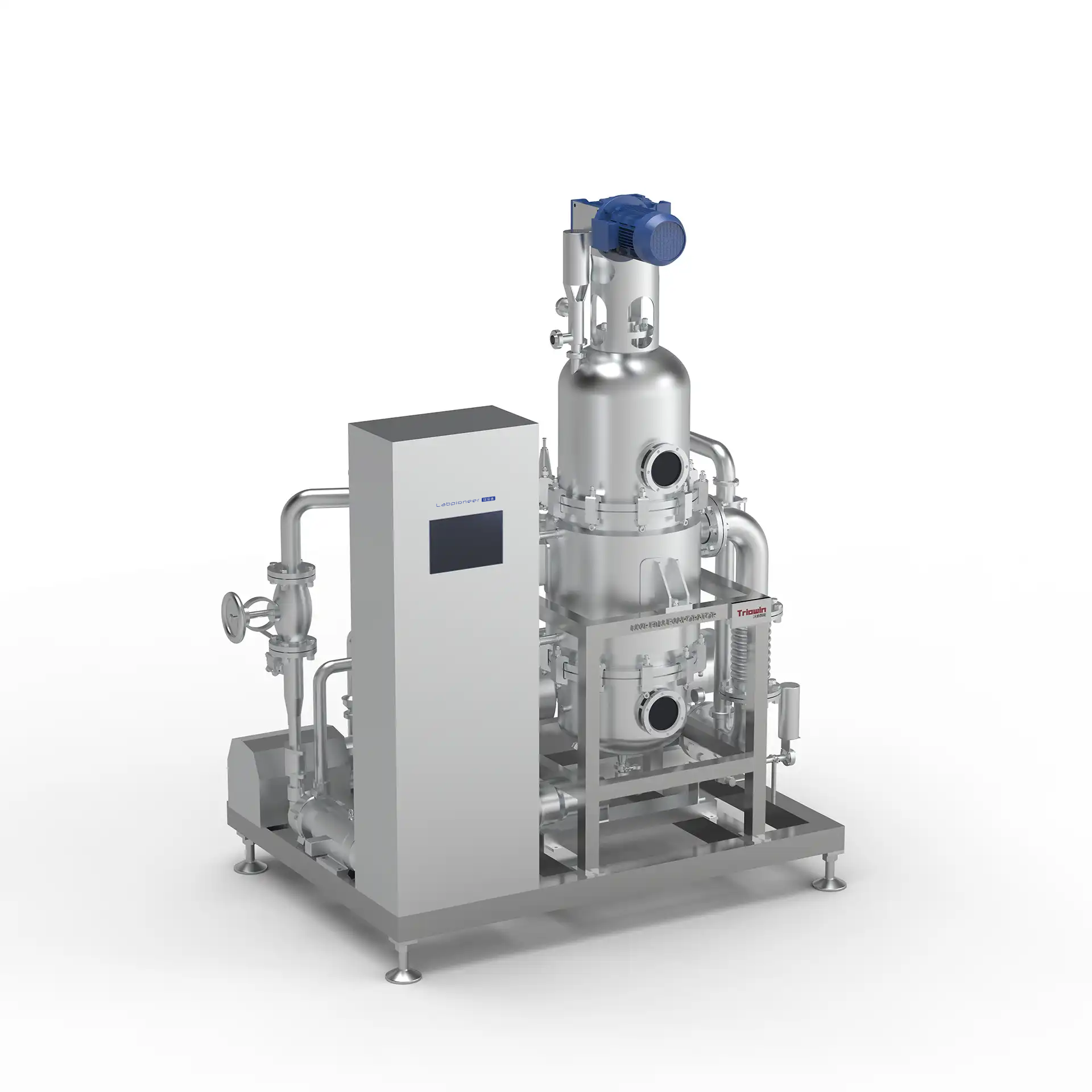
MVR thin film evaporator is a new type of evaporator with strong adaptability. It is suitable for materials with high viscosity, heat sensitivity, and easy crystallization and scaling. The principle of MVR compressor is to use a high-efficiency steam compressor to compress the secondary steam generated by evaporation, convert electrical energy into thermal energy, increase the enthalpy of the secondary steam , and pump the secondary steam with increased thermal energy into the heater to heat the material, so as to recycle the existing thermal energy of the secondary steam, so that there is no need to generate steam externally, and the purpose of evaporation and concentration can be achieved by relying on the self-circulation of the evaporator.
▪ Save energy and water
Compared with traditional evaporators, MVR evaporators save more than 80% of energy, more than 90% of condensed water, and reduce more than 50% of floor space.
▪ High steam utilization rate
The secondary steam is fully utilized, and the economy of raw steam is equivalent to 30 times that of multi-effect evaporation, which reduces the demand for external heating and cooling resources, reduces energy consumption and reduces pollution.
▪ Gentle evaporation
Since the compressor is used to provide the heat source, the temperature difference is much smaller than that of the traditional evaporator, which can achieve gentle evaporation, greatly improve product quality and reduce scaling.
▪ Simple and reliable
No condenser is required or only a condenser with a very small area is required. The structure and process are very simple, fully automatic, can run continuously, and is safe and reliable.
▪ Low thermal denaturation
The evaporator evaporates the material at low temperature (evaporation temperature 40℃-100℃), the material liquid is uniform, there is no material leakage, it is not easy to coke, and the material heating denaturation is minimal.
▪ Scraper heater structure
Scraper heater structure, high heat transfer coefficient, large evaporation capacity, evaporation intensity can reach 200kg/m2· hr , high thermal efficiency.
▪ Short material heating time
The material heating time is short, about 5-10 seconds, and it works under vacuum conditions, which is more beneficial to heat-sensitive materials, keeping the various components from decomposing and ensuring product quality.
▪ Adapt to a wide range of viscosity changes
It can adapt to a wide range of viscosity changes and can handle both high and low viscosity materials. The material viscosity can be as high as 100,000 centipoise (CP).
▪ Low vacuum resistance
Due to its unique evaporation form, the processed material only forms a film on the evaporation surface and does not accumulate on the evaporation surface. Therefore, there is no problem of the static pressure of the liquid column offsetting the vacuum degree in other evaporation forms (the vacuum degree in other evaporation forms only reflects the vacuum degree on the surface of the liquid phase in the system). The vacuum degree displayed by the system is the vacuum degree of material evaporation.
▪ High evaporation intensity
The increase in vacuum degree reduces the boiling point of the processed material and increases the driving force of the temperature difference between the cold and hot media. The forced action of the scraper makes the liquid film turbulent and thinner. The self-cleaning effect of the scraper inhibits the formation of scale on the heating surface , increases the heat transfer coefficient, and improves the evaporation intensity.
▪ Short heating time
Since the scraper evaporator is a special falling film evaporator, the residence time of the material on the heating surface is very short, about 10-60 seconds (depending on the specifications), which is particularly suitable for processing heat-sensitive materials.
▪ High operational flexibility
The amount of material entering the evaporator per unit time determines the thickness of the liquid film formed on the heating surface. Since the liquid film of the scraper evaporator is formed by force of the scraper, the feed amount can be adjusted within a wide range.